
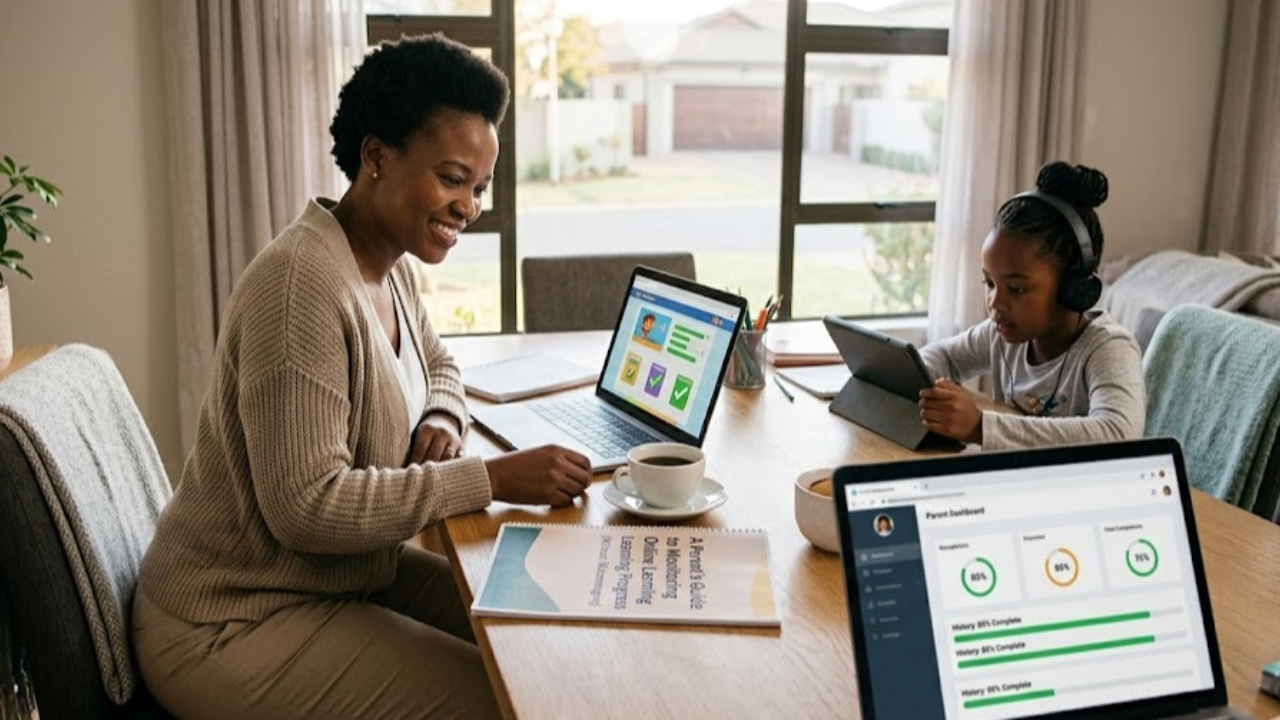
A Parent’s Guide to Monitoring Online Learning Progress (Without Micromanaging)
When parents transition their children to online schooling, they often encounter a challenging psychological paradox. In a traditional brick-and-mortar school, you drop your child at the gate and trust the teachers to maintain order. In an online environment, the classroom moves directly into your home.
Suddenly, you can see every sigh, every distracted click, and every moment of procrastination.
It is incredibly tempting to step into the role of a hyper-vigilant invigilator—hovering over their shoulder, policing their screen time, and checking their progress every twenty minutes. In algebra, however, we learn that adding too much pressure to one side of an equation does not solve it; it completely breaks the equilibrium. Over-monitoring, or micromanaging, often breeds resentment and anxiety, causing learners to shut down.
In the ancient root of algebra, al-jabr means "the restoration of balance." To help you maintain peace in your household while ensuring your teenager actually gets those top marks, here is our guide to balancing the monitoring equation.
1. Establish the "Constants" First
In any algebraic expression, variables shift, but constants remain completely fixed. To give your child the freedom to navigate their online studies, you must first establish the non-negotiable constants of their daily routine.
-
The Fixed Workspace: Ensure they have a dedicated, quiet, and well-lit study area away from the bed. This structurally separates "rest time" from "school time."
-
The Timetable: Online learning offers flexibility, but it shouldn't mean chaos. Sit down together and agree on fixed starting and ending times for the school day. Once these constants are locked in, step back and let them manage the hours in between.
2. Audit the Output, Not the Process
One of the greatest traps of micromanagement is focusing entirely on how a learner is sitting at their desk. Staring at a laptop screen for six hours does not automatically mean learning is happening. Instead of monitoring the process, focus your energy on auditing the output.
Don't ask: "Have you been working all morning?"
Instead, look at the tangible results: "Show me the summary notes you wrote for Module 3," or "Let’s log in and look at your score on yesterday’s geometry quiz."
By focusing on completed tasks, submitted assignments, and concrete notes, you shift the responsibility onto the learner to prove their progress through results, not just appearances.
3. Conduct Weekly "Equilibrium Checks"
Instead of daily policing—which creates friction and leaves you feeling like a warden—treat your tracking like a weekly business or accounting review.
Set up a fixed, 15-minute meeting at the end of every week (perhaps on a Friday afternoon before the weekend freedom begins). Use this time to look at their online dashboard together.
-
Review completed modules.
-
Check for any flagged or outstanding assignments.
-
Celebrate the wins (like mastering a tricky calculus concept).
-
Address the gaps objectively, without anger.
This predictable structure teaches high school learners accountability and mimics the real-world environments they will encounter at university and in their careers.
4. Allow Them the Freedom to Fail (Gently)
True wisdom is rarely born from perfect containment; it is developed by navigating errors. If you notice your child lagging behind on a deadline or struggling with a specific mathematical concept, resist the immediate urge to step in and fix it for them.
Let them experience the minor consequence of a lower mark or a late notification from their online tutor. Use that moment as a collaborative pivot point. Ask them open-ended questions: "What do you think went wrong with your time management this week, and how can we adjust the equation for next week?"
Trusting the System
At The School of Mathematics, our online learning platform on Kajabi is intentionally designed to give parents absolute peace of mind without requiring you to teach the lessons yourself. With clear modular progression, automated tracking, and transparent performance metrics, you can easily verify that your child is mastering the CAPS curriculum at a glance.
Your role isn't to be the mathematician solving the problem for them. Your role is to be the steady constant that holds the framework together while they discover the value of the unknown variable (x).
Let’s build that independent, confident mindset together. Explore our parent resources and student modules on our portal today!