Pure Maths VS Maths Lit VS Technical Maths - The Grade 9 Pivot Point
Every year around the third term, a familiar wave of anxiety hits South African households. Grade 9 learners are handed a form that will effectively map out the trajectory of their final three years of high school—and potentially their adult lives. It is time for Subject Selection.
Among all the choices (History vs. Geography, Accounting vs. Business), the biggest, most fiercely debated decision always sits at the top of the page: What are we doing about Mathematics?
To help parents and learners navigate this crossroad, let’s unpack the divine design, real-world application, and career pathways of South Africa’s three mathematical streams.
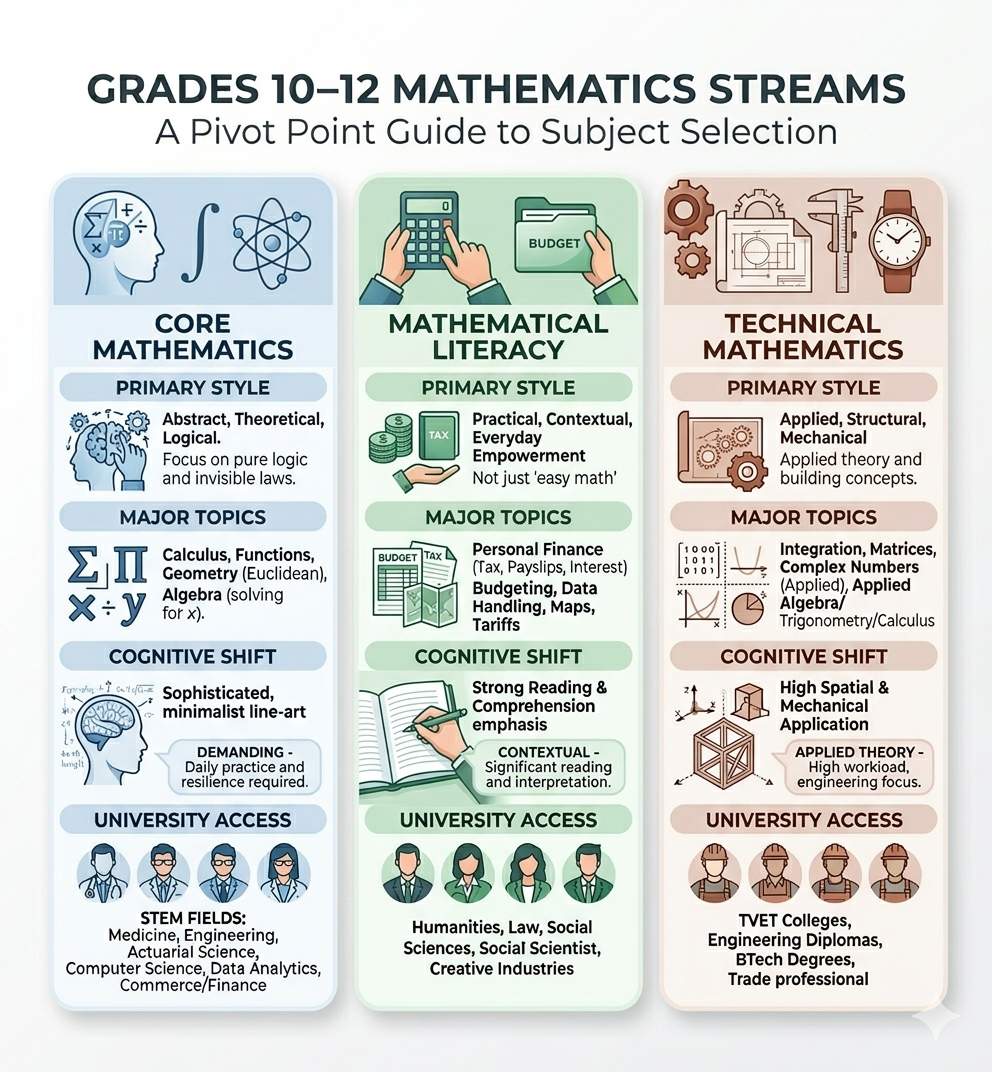
1. Core Mathematics (The Abstract Unknown)
This is the traditional, academic Mathematics stream. It is the language of pure logic, functions, patterns, and space.
-
The Focus: Core Maths moves away from concrete numbers and dives deeply into the abstract. It requires learners to solve for the unknown (x), manipulate complex algebraic expressions, master Euclidean geometry, and navigate differential calculus.
-
The Divine Angle: It challenges the mind to see the invisible laws and blueprints that govern the universe.
-
The Career Pathways: Non-negotiable for STEM fields. If your child wants to study Medicine, Engineering, Actuarial Science, Computer Science, Data Analytics, or Commerce (accounting/finance) at a traditional university, they must take Core Maths.
-
The Reality Check: It is highly demanding. It requires daily practice, structural problem-solving skills, and resilience.
2. Mathematical Literacy (The Earthly Application)
There is a massive misconception in South Africa that Maths Lit is simply "easy math for learners who can't cope." This narrative is incorrect. Maths Lit is an entirely different discipline focused on real-world, everyday empowerment.
-
The Focus: It completely ditches abstract algebra, calculus, and theoretical geometry. Instead, it teaches practical, life-applicable mathematical tools. Learners deal with personal finance (tax thresholds, compound interest, payslips, inflation), data handling, maps, plans, and measurement.
-
The Divine Angle: It provides the practical wisdom needed to steward resources, manage earthly affairs efficiently, and understand the structures of modern society.
-
The Career Pathways: It opens doors to the Humanities, Law, Social Sciences, Arts, Education, and various creative industries.
-
The Reality Check: While it avoids abstract thinking, it involves massive amounts of reading comprehension and contextual interpretation. A learner who struggles with wordy, dense problem-solving may still find Maths Lit exams challenging.
3. Technical Mathematics (The Architect's Practicality)
Introduced as part of the Department of Basic Education's "Three-Stream Model," Technical Mathematics bridges the gap between the purely abstract and the heavily practical.
-
The Focus: It covers complex topics similar to Core Maths (like algebra, trigonometry, and calculus) but applies them directly to engineering, mechanics, and technical trades. It integrates concepts like complex numbers, matrices, and circles in a highly structural, real-world engineering context.
-
The Divine Angle: It mirrors the mindset of the builder and the craftsman, turning high-level theory into physical, structural reality.
-
The Career Pathways: Designed specifically for learners enrolled in Technical High Schools. It perfectly articulates into TVET Colleges, engineering diplomas, BTech degrees, and technical trades (like electrical, mechanical, and civil engineering fields).
-
The Reality Check: It is not a "soft option." It carries a similar cognitive workload to Core Maths but is tailored for those who learn best when they can see how a formula physically builds or moves something.
The Comparison Matrix
To help you see the full equation at a glance, here is how the three streams stack up:
How to Choose Without Fear
When filling out that Grade 9 form, look at your child's current performance, but more importantly, look at their purpose.
If their dream career requires Core Maths, the path is clear: keep it, protect it, and put in the work. If their gifts lie firmly in the creative arts, languages, or social fields, forcing them through abstract calculus might cause unnecessary academic trauma when Maths Lit could protect their overall Admission Point Score (APS) for university.
Wherever your child lands, The School of Mathematics is built on the official DBE curriculum framework to ensure that no matter the variables in their textbook, their solution for success remains absolute.